Este post compartilhado pelo Paulo Jr é esclarecedor a respeito de baterias recarregáveis. Recomendo a leitura!
I was standing in line at a local electronics store the other day when I struck up a conversation with the guy ahead of me who had a basket full of battery chargers and AA rechargeable batteries. It turns out he had decided to replace all of the batteries in his house with the rechargeable kind. Between the batteries and the chargers this guy plunked down over a hundred bucks!
He was so proud, telling me about all the money he was going to save.
I didn’t have the heart to ask him if he had the same typical electronic devices found in most homes, because if he did then he probably ended up spending a lot more money than he should have.
Rechargeable Batteries Aren’t Always Cost Effective!
I realize many people want to convert to rechargeable batteries for environmental reasons, which is fair enough. But the truth of the matter is this: when cost is the primary discriminator, low current-draw devices simply don’t warrant the extra expense of rechargeable batteries. That’s because the batteries of low current-draw devices are typically changed so infrequently that the payback period for equivalent rechargeable batteries would be too far long to justify the investment!
For example, it makes much more sense to use traditional alkaline batteries for low-draw devices like your wall clocks, radios, smoke detectors, programmable thermostats, and remote controls because they lose power at a much slower rate than rechargeable batteries.
And because traditional alkaline batteries can hold a charge for years when not in use, they are also the better choice for items that may sit unused for long period of time, like your alarm clock back-up battery and emergency flashlights.
When it comes right down to it, these low current-draw and/or low-use devices make up the great majority of battery-driven products in the typical home.
Okay. So When Do Rechargeable Batteries Make Sense?
Rechargeable batteries are really intended for moderate to high current-draw devices that get at least moderate use. Typically, these are devices that require a battery change every 30 to 60 days.
In my house the only item that clearly met that criteria and, therefore, justified the added up-front costs of rechargeable batteries, was the kids’ Wii gaming system. That is a perfect example of a high-use device where rechargeable batteries will save you a lot of money in the long run.
But for my household those are the only items where rechargeable batteries make sense.
“But, Len, what about my wireless keyboards and mice? Those get a lot of use!”
Well, as my article on the practicality of wireless mice and keyboards noted, rechargeable batteries didn’t even make financial sense for those devices, based upon my battery usage over an 18-month period – I only spent a little over $18 on replacement batteries during that period. But a set of eight good rechargeable AA batteries (five for the mouse and keyboard plus three spares) would set me back roughly $24. Add in the cost of the charger (a good one can run upwards of $40) and you can see that the payback period on the rechargeable batteries becomes a real issue. Remember, rechargeable batteries eventually go bad too, so you’ll need your batteries and charger to last at least until the payback period is reached if you want to recoup your costs in a reasonable amount of time.
How Do I Know Which Type of Rechargeable Battery to Buy?
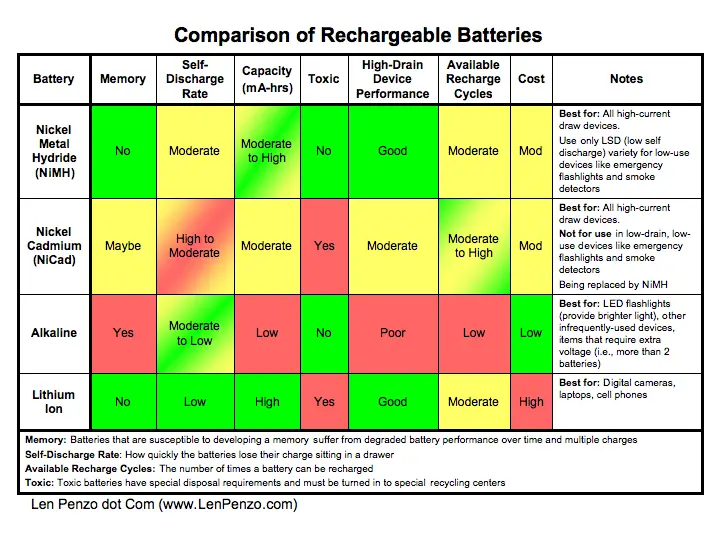
If and when you decide you want to buy rechargeable batteries, you’ll need to know that there are essentially four types to choose from: nickel metal-hydride (NiMH), nickel cadmium (NiCad), rechargeable alkaline, and lithium ion.
NiMH rechargeable batteries typically perform better than NiCads and are free of toxic heavy metals. Generally speaking, NiMH is the best all-around choice for most rechargeable battery applications. As an added bonus, most NiMH battery charger systems can accommodate NiCad batteries too (although the opposite is not true).
NiCads are being phased out in favor of NiMHs not only because they are losing the performance war, but also because of their inconvenience; the heavy metals used within the NiCad are toxic and require special disposal needs.
Rechargeable alkaline batteries have only two real advantages over NiMHs and NiCads: low cost and no need for special recycling. Otherwise, their long-term performance and recharge characteristics make these batteries a poor choice. Rechargeable alkaline batteries also require a special charger, which reminds me: don’t ever confuse rechargeable alkalines with the typical disposable alkaline batteries that are sold everywhere from 99-cent stores to the local grocery market – although some people do it, those batteries cannot be safely charged.
Lithium Ion batteries have great performance and can go unused for long periods without losing their charge. The big drawback is their price; not only are lithium ion batteries much more expensive than other types of rechargeable batteries, but they also require a special charger. Use them for rarely-used or high-drain devices like laptop computers, digital cameras, cell phones or portable televisions.
To help you decide which rechargeable battery is right for you, here is a trade summary I put together of the four basic options:

Some Final Thoughts and Recommendations
- A bad battery charger will prematurely age and greatly shorten the lifespan of your rechargeable batteries. Cheap chargers work too quickly, thereby heating the batteries, which damages them over time. Good chargers will keep your your batteries from getting too warm.
- Batteries should always be removed from their chargers after recharging.
- More expensive battery chargers extend the life of your rechargeable batteries by properly monitoring and controlling the charging process; many also shut off when charging is complete.
- If you do use rechargeable batteries, be sure to keep several spare batteries ready to go at all times so you can swap them out when needed.
- If you do choose to swap out all of your devices with rechargeable batteries, you can spread out your initial costs by replacing only the moderate-use devices first. You can then buy rechargeable batteries for the low-draw devices as needed.
- For info on NiMH rechargeable batteries and battery chargers, check out this article from MetaEfficient.
To Summarize…
Rechargeable batteries are great for moderate to high use devices that drain batteries quickly, but they are not cost effective for low current-draw and/or low-use devices – and it is the low current-draw devices that tend to make up the great majority of battery-driven products in the typical home.
Hopefully, the gentleman I met at the hardware store has a lot of high current-draw, frequent-use devices at his house – otherwise, he probably made a big mistake.




 Postagens

